The future of work is exciting
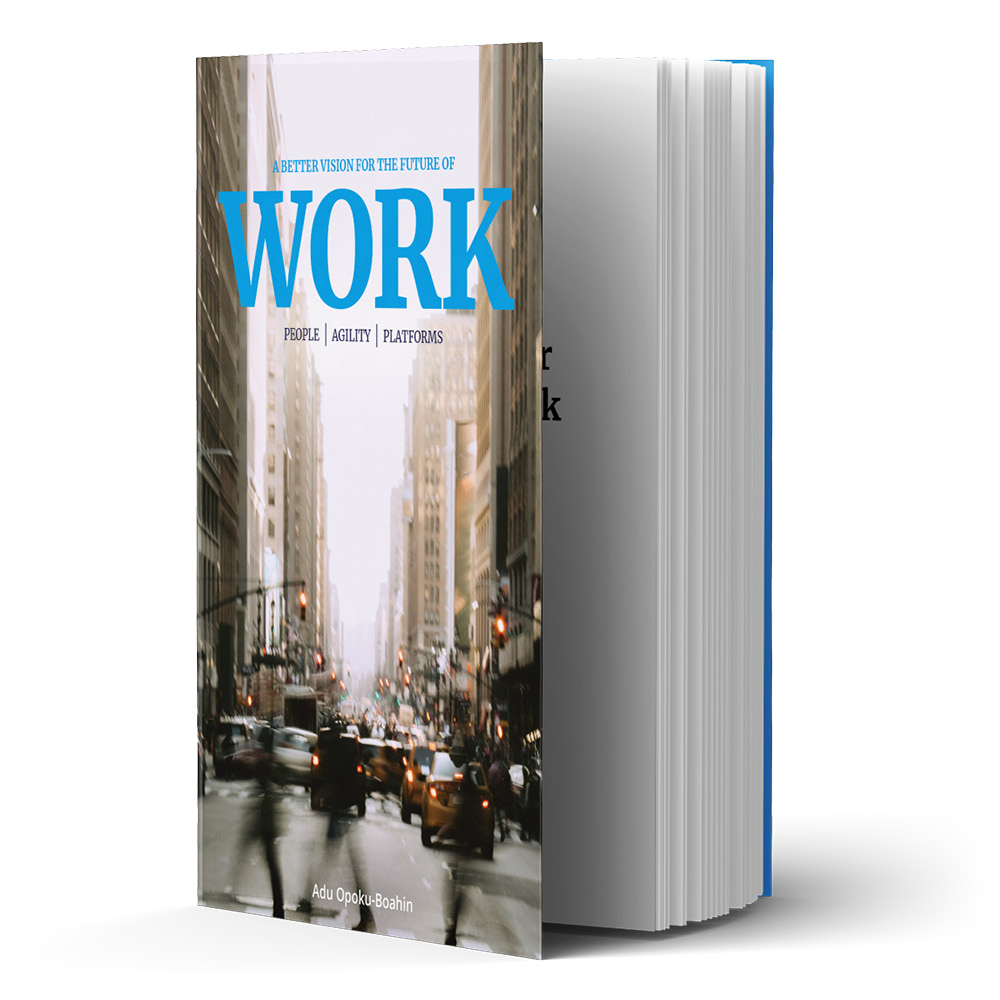
It is something we can collectively create and is only limited by our imagination. With this opportunity comes responsibility; we need to think carefully and create something we are proud of. The real future of work is about you, and me, and the generations that come after us. The real future of work has got to be about people.
A better vision for the future of work:
- explores ideas for the future of work
- looks at the role of people, agility and platforms
- helps readers imagine their place within it
- offers workshops and exercises to embed future-thinking today
The future of work is exciting
It is something we can collectively create and is only limited by our imagination. With this opportunity comes responsibility; we need to think carefully and create something we are proud of. The real future of work is about you, and me, and the generations that come after us. The real future of work has got to be about people.
A better vision for the future of work:
- explores ideas for the future of work
- looks at the role of people, agility and platforms
- helps readers imagine their place within it
- offers workshops and exercises to embed future-thinking today
Chapter list – what’s in the book?
— Congratulations, you got the job!
— What do I know?
— How to use this book
— Thinking ahead
— Blurred vision
— Clearer vision
— When is the future?
— What if?
— Is the future where you want to work?
— Who’s creating the future?
— My vision for the future of work
— Join the community
— Creating the future of work
- Congratulations checklist
- Future thinking (for organizations)
- Rethinking your EVP (for organizations)
- See your blind spot: a checklist for leaders
- Strategic consequences workshop
— Acknowledgements
— About the author
— Congratulations, you got the job!
— What do I know?
— How to use this book
— Thinking ahead
— Blurred vision
— Clearer vision
— When is the future?
— What if?
— Is the future where you want to work?
— Who’s creating the future?
— My vision for the future of work
— Join the community
— Creating the future of work
- Congratulations checklist
- Future thinking (for organizations)
- Rethinking your EVP (for organizations)
- See your blind spot: a checklist for leaders
- Strategic consequences workshop
— Acknowledgements
— About the author
— Congratulations, you got the job!
— What do I know?
— How to use this book
— Thinking ahead
— Blurred vision
— Clearer vision
— When is the future?
— What if?
— Is the future where you want to work?
— Who’s creating the future?
— My vision for the future of work
— Join the community
— Creating the future of work
- Congratulations checklist
- Future thinking (for organizations)
- Rethinking your EVP (for organizations)
- See your blind spot: a checklist for leaders
- Strategic consequences workshop
— Acknowledgements
— About the author
SAMPLE CHAPTER
Blurred vision
The Problem with the Future of Work
I don’t have all the answers, no one does. Some people, on the other hand, have a lot of ideas about the Future of Work. I have more questions than ideas, questions that I will share with you later in the book. For now, I want to explain why I wanted to propose a better vision for the Future of Work. So why is my vision better than the other vision? What’s wrong with the Future of Work as we know it?
Most ideas I read about the Future of Work are technology-first or technology-led. Of course, there are advancements in technology. The rate of change is exponential. Computer processors get better, we can process more data, more rapidly. We can learn things, we can ‘predict’ things, we can automate things. It all gets better faster.
We can replace being somewhere in persona with being behind a screen. We can then replace being behind a screen with being in the metaverse. We can augment our reality. We can work in virtual reality. We can work until computers can work instead.
While I am enthusiastic about the role technology in all its forms (software, data, processing power, AI,) can have on the notion of work, a focus on technology forgets the most important aspect of work, and that’s people. Human capital is still the number one ingredient in work, unless we’re discussing manual processes which can be performed by robots – which we’re not. Technology Utopianism, the idea that advances in technology will create a utopia, is problematic in my opinion. While technology has been used to solve many social problems, it has created others. Just look at the power now wielded pretty much unchecked by social media giants. This is not in the societal interest. No, technology can create great good, but it can create great harm. And the reason why? Because it’s not the technology in charge, but people. When we focus too much on technology, people are in a blind spot.
Many visions of the Future of Work, those that talk about connectivity, engagement, screen time, online collaboration, measurement and so on, really do little to solve what’s wrong with work today. Such visions are incremental developments; I wouldn’t even go so far as to use the word ‘innovation’. Above all else, my issue with cautious, near-term, tech-focused visions of The Future of Work is that it is entirely biased towards the incumbent power structure. These ideas help organizations wield more power, shore up their positions, and do little or nothing at all to solve structural inequalities. There are still some massive problems with the world of work, issues that hold our society back, and I for one, when imagining a Future of Work, would like to imagine one which tackles the issues that affect people.
Many of today’s visions of the future of work are somewhat blurred. They’re blurred, not because we can’t envisage the future, but because we are so influenced by the present. I am keen that we learn to look beyond the present, to imagine a world without our current issues, so that we can picture something far more exciting. Work is central to our lives, we have a great opportunity to not only change the Future of Work, but to change the shape of the society in which we live.
Failed Futures
Some new ‘futures’ have come along: the gig economy, virtual meetings, co-working, hot desking, and zero-hours contracts. Many of these new innovations which promised such change and empowerment have also failed or, at the very least, not delivered what they promised. Let’s take a look at some of them.
In 2005, co-working was a new idea. Imagine a group of technologists in California in a nascent tech startup scene. Innovators with small, bootstrapped startups; workers at some of the bigger tech companies; freelancers; and people who wanted to land a startup job. Co-working was spurred on by real innovators. The idea was that you’d make your workspace available to anyone who wanted somewhere to work. You’d find like-minded technologists to work alongside, and even if you weren’t working with them, there’d be learning and collaboration by osmosis. Co-working was self-organized, rather scruffy, and importantly, it was free. No money was changing hands; co-working was absolutely not office rental or the kind of place you’d find a corporation camping out.
Fast forward a decade to 2015 and co-working as flexible office hire was firmly established. WeWork was named in Fast Company’s 50 Most Innovative Companies list¹. Nowadays cities are full of co-working spaces, all offering a variety of co-working options, from individual hot-desking to single seats, to fully-blown offices with a range of features. From fully stocked fridges and bars to discounts on legal services, masseuses, discos even. Co-working is big business, it’s highly profitable and geared more towards business than individuals.
No longer is it possible to tweet “looking for a #coworking space today” and be offered a comfy couch and a cup of tea with a like-minded nomadic worker down the road. So why is this a ‘failed future’? Well, I say co-working has failed, not because the co-working businesses we know today are failing. While WeWork indeed failed to IPO in 2019 and famously had to phase out its free beer in 2020 amidst slow growth, it’s not this type of failure that’s key here. No, what’s key is that the very concept of co-working as envisioned by its early adopters and evangelists has failed. And sadly so, because the idea was so appealing. The idea was truly disruptive until it was co-opted by the kinds of office real estate businesses it would have otherwise disrupted. A simple idea that anyone could get involved in has pretty much been extinguished. While it’s still possible to beg, steal or borrow office space if you’re a cash-strapped startup, it’s harder to do so if the people whose offices you want to borrow are all situated within expensive shiny co-working spaces.
The gig economy is, in my mind, another failed idea. It’s not failed because there aren’t any successful gig economy businesses turning a massive profit because, of course, there are. It’s failed because the promise of the gig economy has not been delivered. Most people can get behind the concept of the gig economy as a one; the idea sounds great. Platforms connect workers to work, and workers enjoy radically enhanced flexibility and the ability to work when they want, where they want and as much as they want. Sadly though, it’s not always ‘win-win’ in practice; the structure of platforms being very different from the structure of employers means that workers have far fewer rights than they used to.
By classifying workers as self-employed, some businesses get away with not paying workers minimum wage and/ or required benefits. Indeed, the UK’s supreme court ruled that Uber drivers should be classed as employees and were therefore entitled to be paid (at least) minimum wage and paid vacation². Workers’ rights, by the way, can be far more basic than paid time off – workers who are not classed as employees are not entitled under some unscrupulous contracts to rest breaks. Now, of course, not all gig economy businesses are out to undermine or remove workers’ rights, but the promise of the gig economy as offering an attractive alternative to salaried work has failed to materialize for most. Instead of choosing when and where they work, many are manipulated into working long hours. Systems like reviews and ratings are designed to keep them working, far longer than would be considered sensible for a good work-life balance. And gig economy workers are disposable; if they don’t like it, someone else will instantly take their place. The balance of power sits with the business, the value exchange is almost one way, and the Employee Value Proposition is fundamentally broken. No, the idea of the gig economy, as being about flexibility and equality of opportunity, at least, has well and truly failed.
I also see failure, to a great extent in the virtualization of today’s work. By virtualization, I mean our online remote working. For many of us, this started with Covid, but now, in our post-Covid world, there are no signs of it reversing. We’ve been virtualized. The idea was a decent one, that we can work remotely from pretty much anywhere and still get our jobs done. To some people, this meant working from home and having a little more time to see the kids, to others it means working on a beach. I for one, love this idea and genuinely hope we can make this work for people long term. I’d go further than that actually, and say I’d like to help people to work remotely, that I believe in it and that it’s something organizations should strive to make work. I take issue though with the situation many workers find themselves in today.
While all workers who were sent home in Covid have learned it’s possible to do the work from home, many of those know it’s not without its downsides, and not without its unintended consequences. Office space has been reduced, so now when workers go into offices, the offices they were used to are less welcoming. The space that used to be theirs is theirs no longer. Without a physical presence in a building, people feel less autonomy, less attachment, and less engagement. Furthermore, working from home means giving up part of your home to your employer without being compensated for doing so. Reductions in travel costs may be offset by increases in heating costs. The fact that most people don’t have extra rooms in their homes to dedicate to work, means work invades home life. And home life encroaches upon work. It is harder to focus, harder to concentrate, and ultimately harder to enjoy either thing. Mental health problems are on the rise, caused by loneliness and a lack of engagement³.
There are plenty of other failed futures, ideas that once seemed so good, that have been co-opted or manipulated out of all recognition and actually made the world of work worse, not better. What’s interesting about these three ideas, however, is that they may all look like they’re supported by technology, and they are, but the reasons they failed are not technology’s fault. It’s people’s implementation or adaptation of good or great ideas that are key here. In the case of co-working, a simple and very human idea was co-opted and commercialized until none of the benefits of the original idea remain. In the case of the gig economy, the promised freedom for workers not only didn’t materialize, but the gig economy went further and made things much worse for millions of workers. And in terms of the virtualization of work, we need to remember we are people. Human interaction is vital to us, we need and indeed thrive on engagement and collaboration and therefore we require a sharper focus on ensuring we have those things while working ‘remotely’.
The Real Future of Work
For me, the Future of Work is not about near-term tech enhancements. It is about mid-and long-term people-centric innovation. It should change how we work, how we operate as organizations, and how we live as a society for the better. The Future of Work cannot deliver if we think too short-termist, are singly profit-oriented, or if we forget we are people with very human needs.
The Future of Work must be people-first and people-led as opposed to technology-first and technology-led. Technology is vital in the Future of Work. Good technology must be developed to help us with some of our smaller issues and fundamental concerns. People and technology must work together, not on the frivolous design of an enhanced ‘workplace experience’, special interest clubs and gym membership, but on the big issues we all need to solve like fixing the structural inadequacies of work today.
—

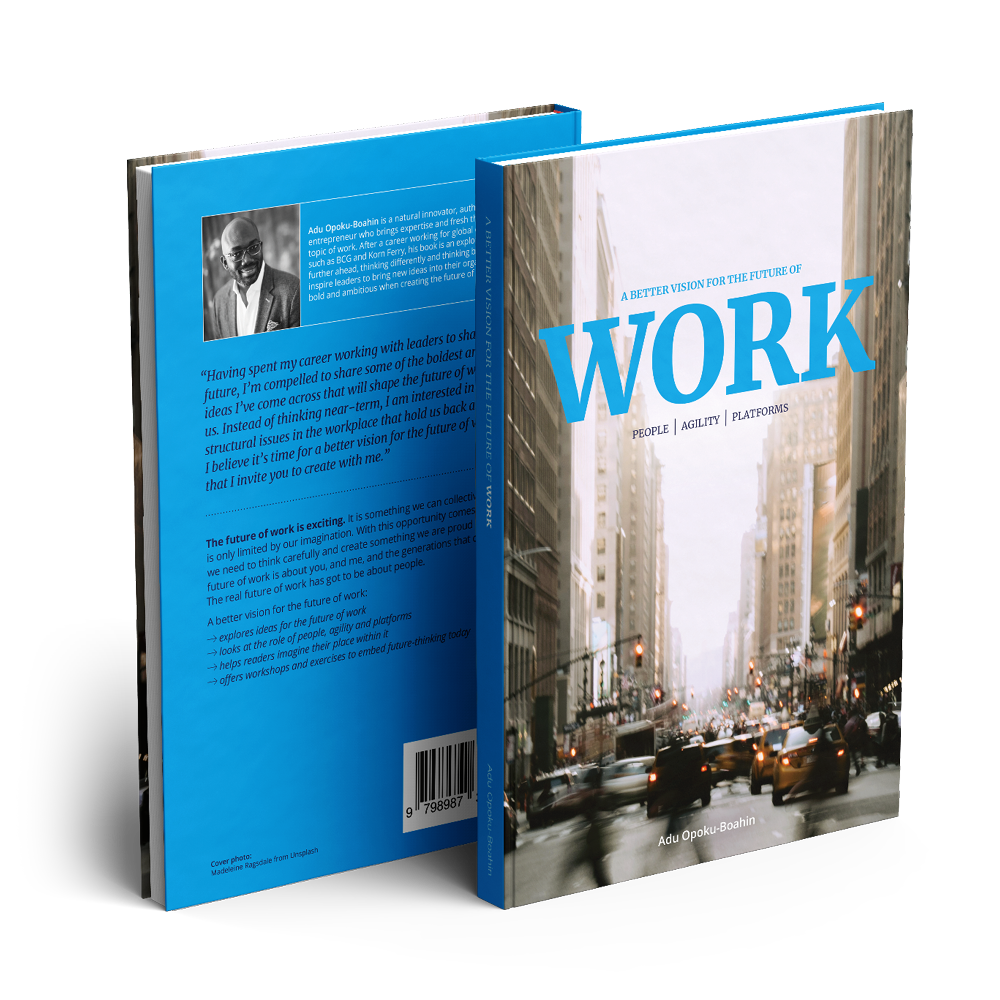
Adu Opoku-Boahin is a natural innovator, author and entrepreneur who brings expertise and fresh thinking to the topic of work. After a career working for global organizations such as BCG and Korn Ferry, his book is an exploration in thinking further ahead, thinking differently and thinking boldly. He aims to inspire leaders to bring new ideas into their organizations, to be bold and ambitious when creating the future of work.
“Having spent my career working with leaders to shape the future, I’m compelled to share some of the boldest and brightest ideas I’ve come across that will shape the future of work for all of us. Instead of thinking near-term, I am interested in tackling the structural issues in the workplace that hold us back as a society. I believe it’s time for a better vision for the future of work, one that I invite you to create with me.”
Where can I buy the book?
‘A better vision for the future of work’ can be bought from Amazon in hardback, paperback and Kindle editions.
Downloads
I’ve created a series of exercises to get you started in creating either your own personal Future of Work, or the Future of Work for people within your organization. These tools are easy to use and light touch. They’re conversation starters. Use them as you see fit and share them.
Downloads
I’ve created a series of exercises to get you started in creating either your own personal Future of Work, or the Future of Work for people within your organization. These tools are easy to use and light touch. They’re conversation starters. Use them as you see fit and share them.